Northumberland has around 5,562 listed buildings by the county council's count, from 169 at Grade I to 5,128 at Grade II, and 70 conservation areas, among them Ponteland, Corbridge and Bamburgh. Several of the projects on this site are in period houses, so this is the plain version of a question we are asked a lot: what does listing mean for the inside of a house, and where does an interior designer fit?
What listing covers
A building is listed when it is of special architectural or historic interest, and it is added to the National Heritage List for England. There are three grades: Grade I for the most significant, then Grade II* and Grade II. Grade II makes up 92 per cent of the total, so it is almost certainly what a listed house near here will be.
The part people most often get wrong is the scope. Listing covers the whole building, inside and out, unless the list entry specifically excludes part of it. That is Historic England's wording, and the government's planning guidance says the same: internal and external, plus objects fixed to the building, later extensions, and pre-1948 buildings within the curtilage, the land attached to the house. So a cornice, a staircase or a run of panelling is protected just as the front elevation is.
Listed building consent is needed for any work that would affect the building's character as one of special interest, whether or not planning permission is also needed. The two are separate regimes. There is no fee for a listed building consent application. Carrying out the work without consent is a criminal offence under section 9 of the Planning (Listed Buildings and Conservation Areas) Act 1990, and Northumberland County Council notes that this applies even if you did not know the building was listed. The council can require the work to be reversed, and an unauthorised alteration tends to surface when the house comes to be sold.
Conservation areas are a different thing
A conservation area protects the character of a place rather than a single building, and living in one does not mean the inside of your house is controlled. Historic England's guidance is that the extra controls are most likely to affect the outside of a building and the trees in its garden. Permitted development rights are narrower, so things like two-storey extensions, dormer windows and stone cladding need a planning application, demolition needs planning permission, and work to all but the smallest trees needs six weeks' notice to the council. Some conservation areas also carry an Article 4 Direction, which removes permitted development rights for specific things such as replacing a door or a window, and in some areas there are controls on external colours. Northumberland publishes a character appraisal for many of its conservation areas, Corbridge and Bamburgh among them, worth reading before anything is planned.
Darras Hall has its own estate byelaws on top of any planning rules, which we have written about separately.
What usually needs consent, and what usually does not
In a listed house, as we understand the published guidance, and always subject to the local planning authority's view:
- Usually needs consent. Removing or altering original features. Historic England names wall panelling, plaster cornices, picture rails and the timber mouldings around doors and windows as valuable features that need consent to take out, and the same logic generally applies to fireplaces and staircases. Changing the layout, removing or inserting walls, fitted kitchens and bathrooms that cut into historic fabric, and new services run through old walls may all need consent. Outside, painting a wall that has never been painted, or a colour change that alters the building's character, can need permission too.
- Usually does not. The things that are not works to the building at all. Choosing furniture, rugs, lamps, pictures and loose furnishings. Hanging curtains and blinds from existing fittings. Interior redecoration is, in Historic England's guidance, largely a matter of personal taste, with one caveat: in an important interior there may be early paint layers or wall paintings under later finishes, and a specialist should look before anything is stripped.
The grey area in between is where most real projects live, and the route through it is the one Historic England recommends: speak to the conservation officer at the local planning authority before plans are drawn, find out what is likely to be acceptable, and adapt the idea early rather than late. Where you believe work does not need consent, the county council notes you can apply for a certificate of lawfulness of proposed works, which puts the answer in writing.
How we work within it
Our part in a listed or period house is the same as anywhere else: to design rooms that belong to the building. A house with this much character already knows what it wants. The Northumberland Project in Corbridge is a period property whose architecture was confident enough to lead the design, and we followed its lead. At Springfield in Gosforth the ornate cornice was given the quiet it deserves, and the scheme was built to honour the bones of the house rather than compete with them.
In practice that comes down to a few habits.
- We look the house up. We read the List entry during the first conversation, because it sometimes says what is significant and occasionally what is excluded.
- We work alongside the people who hold the consent. We work alongside architects and builders at every stage, and on a listed house that includes the conservation officer. Consent is their conversation to lead; ours is to make sure the design does not depend on something that will not be approved.
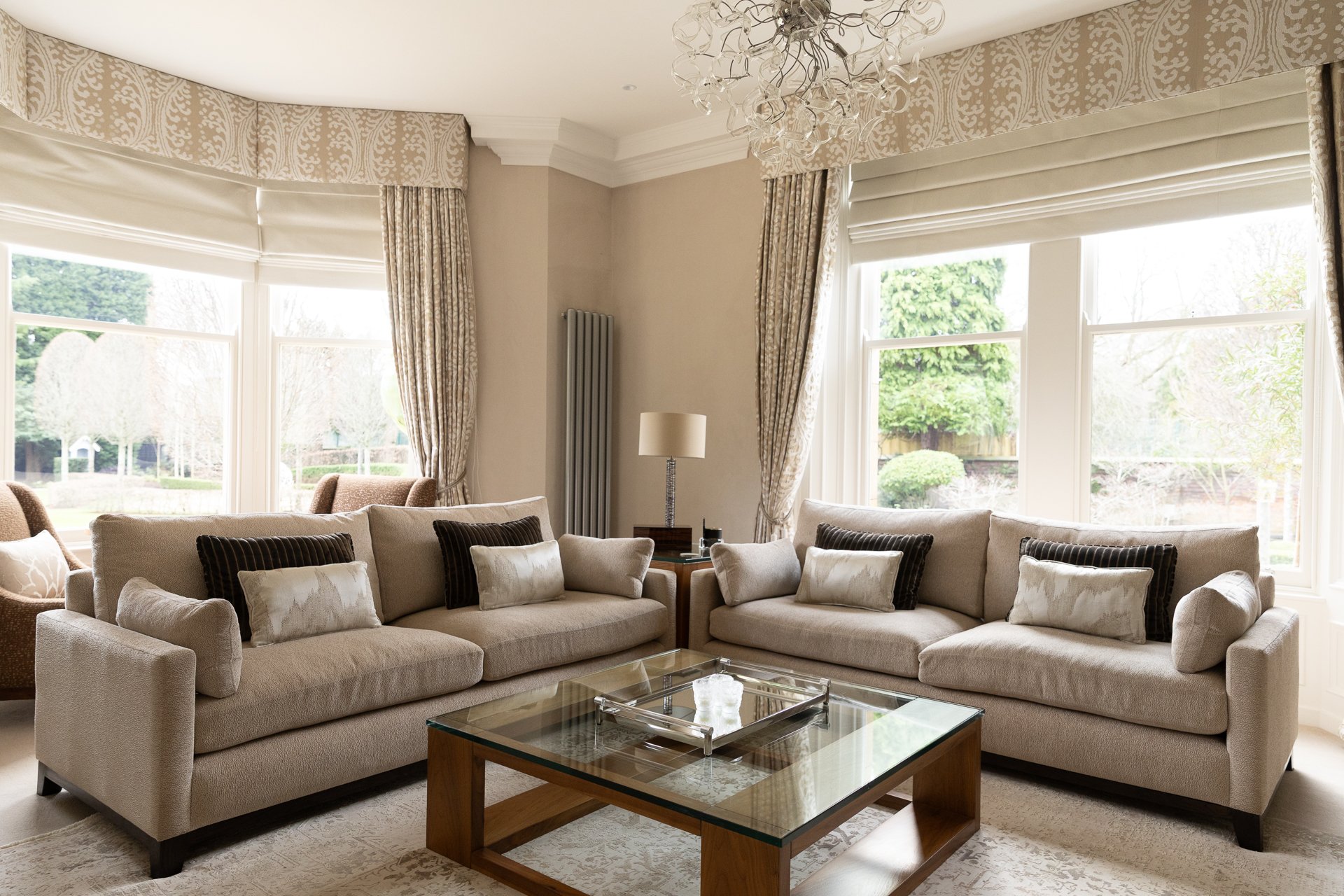
- We favour the reversible. Historic England recommends that additions and alterations to historic buildings should be capable of being reversed, and a great deal of what makes a room feel finished is exactly that: curtains, blinds, headboards, cushions and upholstery made in our own workroom, freestanding furniture, lighting on existing points, paint in the right kind of finish. None of it cuts into the fabric.
- We keep records. Photographs before, during and after, and a note of what was done, which the next owner and the next designer will thank you for.
Always check with the local planning authority. This is a plain summary of published guidance, not legal or planning advice, and every listed building is different. Before any work to a listed building or in a conservation area, confirm what applies with Northumberland County Council's conservation team or whichever local planning authority covers your home.